
I’ve been trying to find a pool.
Not a complicated request. A private pool, maybe with a small spa attached. Local. Open on weekday evenings. Somewhere my partner and I could actually go after work without driving forty minutes or booking three weeks in advance at some countryside hotel that exists primarily for wedding parties.
It doesn’t exist here. Not in any form that fits ordinary life.
And I know how that sounds. I know the version of me that would have rolled my eyes at this paragraph five years ago. A pool? That’s your problem?
Fair enough. But stay with me for a second, because I don’t actually think this is about the pool.
I’ve been noticing, for a while now, a particular kind of absence in the places I’ve lived.
Not poverty. Not the dramatic kind of lack that shows up in statistics. Something quieter than that. The useful thing that doesn’t exist nearby. The service with slightly better hours that you would happily pay for but can’t find. The small business idea that seems so obvious you assume someone must already have done it, until you look and realize they haven’t. Not here. Not in a form that fits real life.
You notice it in opening hours. In the strange gap between cheap and chaotic on one end, and expensive and remote on the other, especially for anything family-oriented. In the difficulty of finding a small local business that solves an ordinary problem with a bit of imagination. In the way everything useful exists, if at all, one village too far away, one format too formal, one system too rigid to bend toward you.
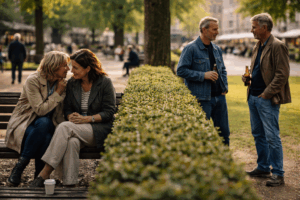
And it isn’t only about leisure. Think of something even more ordinary: a warm, low-threshold indoor place where children can play and parents can sit, rest, have a coffee, or meet someone after school or on a cold afternoon, without needing to consume much and without feeling they have to leave after an hour. Yes, there are buurthuizen, but that is not quite what I mean. Buurthuizen often come with fixed programs, time slots, volunteer rhythms, and an institutional feel. They serve a purpose, but they are not the same as an everyday, flexible place you can simply use when life happens.
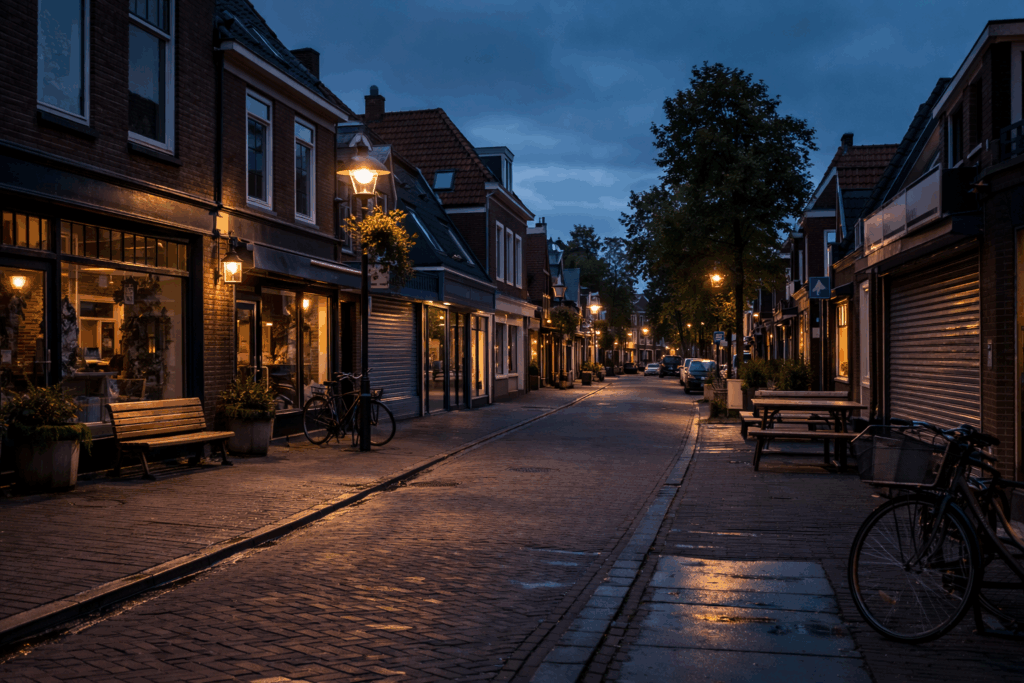
What I also don’t fully understand is how little many neighbourhoods seem designed to allow this kind of place to emerge naturally. Residential areas can be clean, spacious, orderly and still leave almost no room for a small useful in-between layer: a modest café with a play corner, a family room, a semi-public indoor space, a practical local service that people can actually walk to and use spontaneously. Everything is zoned so neatly, so separately, that ordinary life ends up fragmented. You live here, shop there, meet elsewhere, and only if it fits the timetable. I really don’t understand why neighbourhoods are so often structured in a way that leaves so little room for low-threshold, everyday social infrastructure.
And that difference matters more than it seems, because this is also where inclusion quietly succeeds or fails. If the only places available are commercial, overstimulating, scheduled, socially coded, or dependent on knowing how the system works, then many people remain excluded without anyone explicitly excluding them. Newcomers, parents without a network, elderly people, teenagers, families with sensitive children, people with less money, people who do not speak the language confidently, people who simply do not fit easily into organized format, all of them end up with fewer places where they can just be.

I used to think this was just inconvenience. Consumer frustration. The mild disappointment of not finding what you want and moving on.
I don’t think that anymore.
What I’ve started thinking instead is this: when a place offers very few useful everyday options, it is not only a problem for the people trying to find things. It is also a problem for the people trying to build them.
A place like that creates fewer openings. Fewer entry points for someone who sees a missing need and wants to answer it. Fewer chances for the slightly unconventional idea that does not already belong to local habit. Less room for flexible, human-scale businesses, the kind that make a place feel alive rather than merely functional.
And that, to me, is the interesting part.
A place can be stable, clean, well-organized, and still be weak at this. It can cover the basics while offering surprisingly little in between. Structure without layers. Function without vitality.
That is a real thing, and I’m not sure it gets talked about enough.
I keep thinking about newcomers, specifically.
There is a lot of conversation about integration’; language classes, civic participation, abstract goals. But one of the most underrated ways of becoming part of a place is economic. You become part of a society when you can be useful in it. When you can offer something, solve something, build something, be known for something.
If a local economy leaves very little room for that, if the spaces between existing businesses are too narrow, too fixed, or too hard to enter then integration becomes harder than it needs to be. Not only because of attitudes or politics, but because of structure. Because there is not enough room to step in and become visible.
The same logic applies to locals who want to do something new.
A society can complain about labor shortages, overworked systems, and the difficulty of finding help, while still leaving obvious forms of small-scale useful work strangely absent. That contradiction is not only economic. It is also cultural. It has to do with what kinds of businesses feel legitimate, what kinds of services seem worth organizing, and how much room a place gives to ideas that do not already fit its categories.
I don’t have a neat solution to this. I’m not even sure it is the kind of problem that has one. But I do think it has political consequences that are rarely named clearly enough.
Local politics is usually discussed in terms of housing permits, roads, and budgets. Sensible things. But it is also about what kind of life a place makes possible. Whether it offers only the minimum, or whether it leaves enough room for people to experiment, respond, and build the useful in-between layer that makes a society feel like somewhere you can actually do something.
A pool or a neighbourhood cafe is a small thing. Obviously.
But the absence of it points to something larger: a place that is good at preserving its structure, and less good at generating the everyday imagination that structure is supposed to support.