
Author Archives: Wanderlab Family

Read the banners – On what hangs above a city’s streets and what it’s trying to tell you

If you want to understand a city, don’t start with its monuments.

Start with its banners.
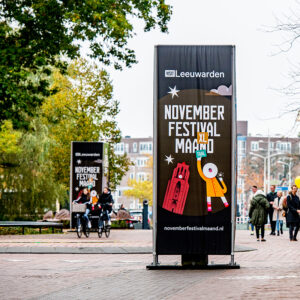
Not the official ones. Not the welcome signs at the station or the tourism slogans on the website. I mean the things hanging above the shopping streets on a random Tuesday. What fills the lamp posts. What gets repeated often enough that locals stop seeing it.

That’s where a city’s real self-image lives, not curated, not dressed up for visitors, just running on habit.


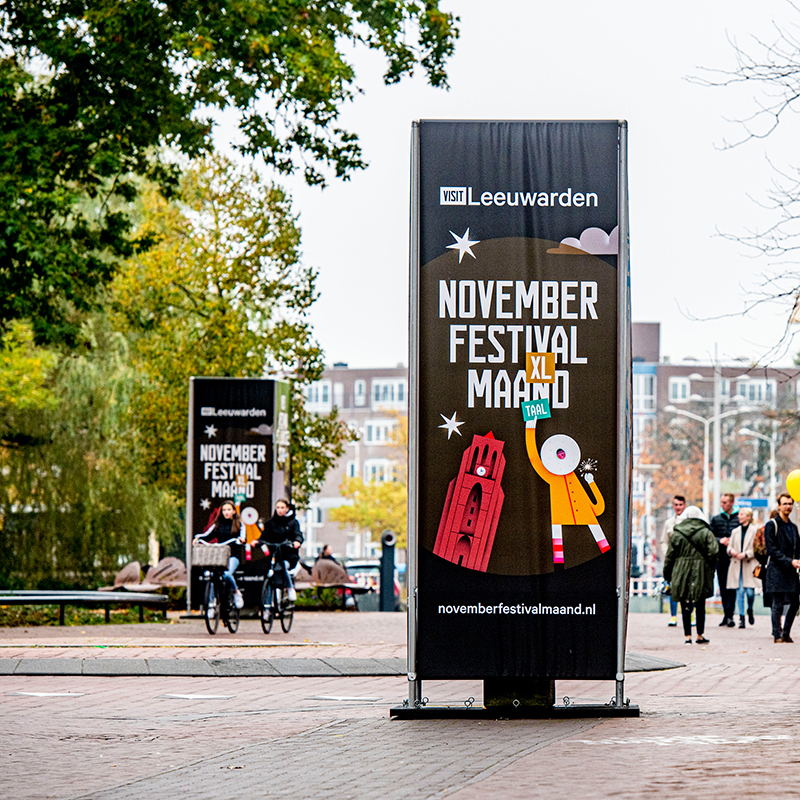
In Leeuwarden, the banners are mostly about shows.

Theatre. Art exhibitions. The Fries Museum. Frisian cultural events. Concerts, festivals, things happening at the Prins Willem-Alexanderhof. Walk through the Nieuwestad on a weekday and the lamp posts are advertising things to experience, not just things to buy.

I noticed this gradually, the way you notice most things about a place you’ve moved to not as a discovery but as a slow accumulation of small observations that suddenly add up.

Other cities advertise differently. Discounts. Chain stores. New housing developments. Fitness offers. Cheap lunch menus. The ordinary management of a functional life. And that kind of advertising tells you something too; it tells you that the dominant public mood is practical, cautious, grounded in what people need rather than what they might feel.

Leeuwarden does have that. Of course it does. But it’s not what the banners reach for.

What the banners reach for is culture. And specifically: Frisian culture.


This is not an accident.

Friesland is one of the few places in Europe that has held onto a minority language with genuine stubbornness not as a heritage project exactly, but as a living daily thing. Frisian is on the road signs. It’s in the schools. It shows up, sometimes unexpectedly, in ordinary conversations. The province has fought quietly for its own distinctiveness for a long time.

The banners are part of that. They are a city saying, repeatedly, to anyone walking through it.That is a particular kind of civic self-confidence. Not loud. Not boastful. But persistent.


I’ve started thinking about what it means to live somewhere that advertises itself through art rather than appetite.

It sets a tone. It shapes what feels normal. What kinds of evenings seem available. What you imagine doing on a Saturday. A city that hangs theatre posters above its streets is making a quiet suggestion about who its residents might be, or who they might want to become.

That’s not nothing.

Advertising is rarely just commercial noise. It’s one of the easiest ways to see what a place assumes people want and what it thinks is worth making visible. A city teaches people what to expect from life partly through repetition. What gets put in front of you again and again starts to define the edges of the ordinary.

In some places those edges are drawn around thrift, routine, consumption. In others around status, glamour, aspiration. In Leeuwarden, they seem to be drawn at least partly around cultural life. Around the idea that a small northern city has something worth seeing, worth hearing, worth coming to.


I’m not saying the banners tell the whole story. They never do.

A city’s official story is told through architecture and history. Its unofficial story is in the shop windows, the noise levels, the faces on a Friday night, the things people line up for. The banners are somewhere in between edited, but not fully managed.

What I find interesting about Leeuwarden’s is what they suggest about self-image. Not buy here or live here for the convenience. More like: we have a culture, and we’d like you to be part of it.

Whether the city fully lives up to that suggestion is a different question.

But it’s a more interesting one to ask than most places give you.


So next time you arrive somewhere new, don’t only look at the buildings.

Read the banners first. Then ask what they’re not saying.


What do the banners look like where you are? I’m genuinely curious whether this pattern holds elsewhere the places that advertise culture versus the ones that advertise convenience, and what that difference feels like to live inside.
When a Private Pool Becomes Relevant to Local Elections

I’ve been trying to find a pool.

Not a complicated request. A private pool, maybe with a small spa attached. Local. Open on weekday evenings. Somewhere my partner and I could actually go after work without driving forty minutes or booking three weeks in advance at some countryside hotel that exists primarily for wedding parties.

It doesn’t exist here. Not in any form that fits ordinary life.

And I know how that sounds. I know the version of me that would have rolled my eyes at this paragraph five years ago. A pool? That’s your problem?

Fair enough. But stay with me for a second, because I don’t actually think this is about the pool.


I’ve been noticing, for a while now, a particular kind of absence in the places I’ve lived.

Not poverty. Not the dramatic kind of lack that shows up in statistics. Something quieter than that. The useful thing that doesn’t exist nearby. The service with slightly better hours that you would happily pay for but can’t find. The small business idea that seems so obvious you assume someone must already have done it, until you look and realize they haven’t. Not here. Not in a form that fits real life.


You notice it in opening hours. In the strange gap between cheap and chaotic on one end, and expensive and remote on the other, especially for anything family-oriented. In the difficulty of finding a small local business that solves an ordinary problem with a bit of imagination. In the way everything useful exists, if at all, one village too far away, one format too formal, one system too rigid to bend toward you.

And it isn’t only about leisure. Think of something even more ordinary: a warm, low-threshold indoor place where children can play and parents can sit, rest, have a coffee, or meet someone after school or on a cold afternoon, without needing to consume much and without feeling they have to leave after an hour. Yes, there are buurthuizen, but that is not quite what I mean. Buurthuizen often come with fixed programs, time slots, volunteer rhythms, and an institutional feel. They serve a purpose, but they are not the same as an everyday, flexible place you can simply use when life happens.


What I also don’t fully understand is how little many neighbourhoods seem designed to allow this kind of place to emerge naturally. Residential areas can be clean, spacious, orderly and still leave almost no room for a small useful in-between layer: a modest café with a play corner, a family room, a semi-public indoor space, a practical local service that people can actually walk to and use spontaneously. Everything is zoned so neatly, so separately, that ordinary life ends up fragmented. You live here, shop there, meet elsewhere, and only if it fits the timetable. I really don’t understand why neighbourhoods are so often structured in a way that leaves so little room for low-threshold, everyday social infrastructure.

And that difference matters more than it seems, because this is also where inclusion quietly succeeds or fails. If the only places available are commercial, overstimulating, scheduled, socially coded, or dependent on knowing how the system works, then many people remain excluded without anyone explicitly excluding them. Newcomers, parents without a network, elderly people, teenagers, families with sensitive children, people with less money, people who do not speak the language confidently, people who simply do not fit easily into organized format, all of them end up with fewer places where they can just be.

I used to think this was just inconvenience. Consumer frustration. The mild disappointment of not finding what you want and moving on.

I don’t think that anymore.

What I’ve started thinking instead is this: when a place offers very few useful everyday options, it is not only a problem for the people trying to find things. It is also a problem for the people trying to build them.

A place like that creates fewer openings. Fewer entry points for someone who sees a missing need and wants to answer it. Fewer chances for the slightly unconventional idea that does not already belong to local habit. Less room for flexible, human-scale businesses, the kind that make a place feel alive rather than merely functional.

And that, to me, is the interesting part.

A place can be stable, clean, well-organized, and still be weak at this. It can cover the basics while offering surprisingly little in between. Structure without layers. Function without vitality.

That is a real thing, and I’m not sure it gets talked about enough.

I keep thinking about newcomers, specifically.


There is a lot of conversation about integration’; language classes, civic participation, abstract goals. But one of the most underrated ways of becoming part of a place is economic. You become part of a society when you can be useful in it. When you can offer something, solve something, build something, be known for something.

If a local economy leaves very little room for that, if the spaces between existing businesses are too narrow, too fixed, or too hard to enter then integration becomes harder than it needs to be. Not only because of attitudes or politics, but because of structure. Because there is not enough room to step in and become visible.

The same logic applies to locals who want to do something new.

A society can complain about labor shortages, overworked systems, and the difficulty of finding help, while still leaving obvious forms of small-scale useful work strangely absent. That contradiction is not only economic. It is also cultural. It has to do with what kinds of businesses feel legitimate, what kinds of services seem worth organizing, and how much room a place gives to ideas that do not already fit its categories.

I don’t have a neat solution to this. I’m not even sure it is the kind of problem that has one. But I do think it has political consequences that are rarely named clearly enough.


Local politics is usually discussed in terms of housing permits, roads, and budgets. Sensible things. But it is also about what kind of life a place makes possible. Whether it offers only the minimum, or whether it leaves enough room for people to experiment, respond, and build the useful in-between layer that makes a society feel like somewhere you can actually do something.

A pool or a neighbourhood cafe is a small thing. Obviously.

But the absence of it points to something larger: a place that is good at preserving its structure, and less good at generating the everyday imagination that structure is supposed to support.

A hospital corridor in Turkey, and what it revealed about public boundaries.

Why Some Societies Step In and Others Hold Back

The Quiet Logic of a Frisian Dinner Table


Garyp was not the kind of place anyone accidentally ends up in. A few houses, a church tower somewhere in the distance, and a calmness that made you feel slightly louder than you intended to be.

The first time I sat at my future in-laws’ dinner table there, I noticed how little in the room was trying to prove itself. Suddenly the gifts I have brought seemed too shiny, as well as my clothes.

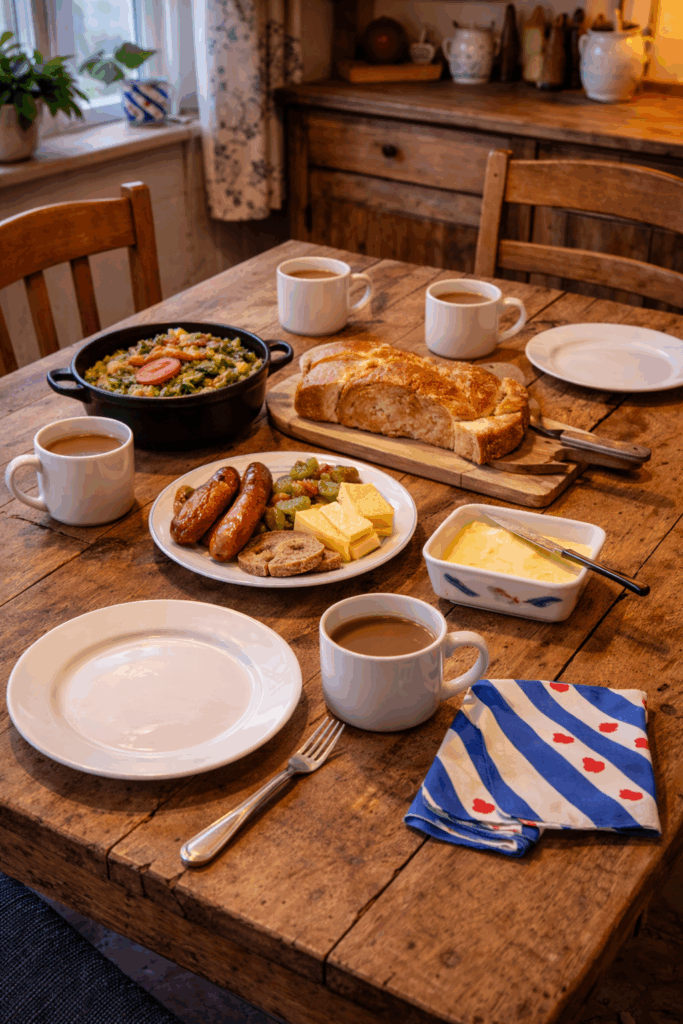
The table was simple: bread, cheese, something warm from the oven. Nothing flashy, nothing arranged for effect. Just food that had probably been eaten in that house for years.


The moment

My future in-laws sat around the table with the calm curiosity of people who are not easily surprised.

They asked questions, they listened carefully. They nodded slowly.

The atmosphere was warm, but without excess. There was no rush to charm, no pressure to fill every silence, and no effort to make the evening feel more special than it already was.

Somewhere between the second slice of bread and the third question about Turkey, I realized something important: I was quietly adjusting myself.

Less hand movement. Slightly softer voice. Enthusiasm dialed down a few notches.

Friesland, it seemed, had a volume setting.

And it was lower than mine.

When simplicity does not mean lack

At the time, I understood this mostly as cultural adjustment. I had entered a room with a different rhythm and was, instinctively, trying to meet it.

But looking back, I think what I was responding to was something more specific than quietness. It was a certain kind of down-to-earthness.

Nothing at that table seemed inflated. Not the food, not the conversation, not the people themselves.

Nobody appeared interested in performing hospitality or turning ordinary life into a statement. Things were allowed to be simple. And simple did not seem to mean lacking.

That was new to me.

A culture with a lower volume setting

In many cultures, warmth comes with energy. Hospitality expands outward. People show interest by asking more, speaking more, offering more.

In Garyp, the room worked differently.

The welcome was there, but it stayed close to the ground. It did not rise into performance. It did not decorate itself.

It just sat there quietly in the bread basket, in the measured questions, in the fact that nobody seemed concerned with making the moment appear meaningful.

And somehow, that made it meaningful.

Why it stayed with me

Looking back, I think that dinner was one of my first real encounters with down-to-earthness as a cultural value.

Not modesty in the moral sense. Not simplicity as an aesthetic trend. Something deeper than that.

An instinct not to exaggerate. Not to make yourself bigger than the room. Not to ask ordinary life to constantly entertain, validate, or distinguish you.

I didn’t leave that dinner thinking I had understood Friesland.

I mostly remember the bread, the careful questions, and the feeling that I was somehow too loud for the room.

But that memory stayed with me. I think because it was one of the first times I saw how a place can express its values without naming them.

In Garyp, down-to-earthness was not an idea anyone explained. It was just there, quietly shaping the table.

Have you ever sat somewhere and felt your own volume as a problem? I keep thinking this is one of those things that only becomes visible when you’re the one who doesn’t quite fit the setting. Curious if others have felt this somewhere completely different, maybe.

Discover Sommarøy: Norway’s Time-Free Arctic Paradise

Where time stands still and the sea never sleeps.

Just an hour west of Tromsø, lies Sommarøy, an Arctic island escape Norway. A scatter of islands linked by slender bridges, white-sand coves, and Arctic-blue water that glows under the midnight sun. Life here moves in rhythm with the tides, unhurried, salt-streaked, and free.

Why visit Sommarøy? Because this is what an Arctic island escape in Norway feels like bright white sand, turquoise water, and endless light. A place where you can breathe deeply, slow down, and watch time dissolve into sea and sky.

The Feel

Sommarøy is small. It’s the kind of place where you can hear the wind shift, where locals leave their doors unlocked, and where the line between day and night blurs in summer light. The island once proposed to become the world’s first “time-free zone”  not as a stunt, but as a reflection of how life already feels here. When you’re surrounded by endless light, the clock loses meaning.

What to Do

Hike Ørnfløya:  a gentle climb with vast views across turquoise shallows and tiny islets. Bring a thermos and sit at the top watching fishing boats drift below.
Walk across the bridges: connecting Sommarøy, Hillesøya, and smaller skerries, every turn feels like a new painting.
Swim or don’t swim: the water looks tropical but stays Arctic-cold. Most people wade in, take a breath, and laugh.
Sauna & sea plunge: the Sommarøy Arctic Hotel has a glass-front sauna right on the water. Jump straight into the sea, then back to warmth.
Stay up late: or don’t sleep at all. The midnight sun turns the sea silver and the horizon gold.

When to Go

  • May to July: Midnight Sun, wildflowers, long days that never end.

  • September to March: Northern Lights, crisp air, and cozy light inside every window.

  • April & August: shoulder seasons with fewer people and soft light.

Getting There

Fly to Tromsø (TOS) and rent a car. From the city, drive about one hour west through fjords, reindeer pastures, and quiet fishing villages. The road itself feels like part of the experience.

Where to Stay

Sommarøy Arctic Hotel, minimalist Nordic interiors, wide sea views, and everything within walking distance. Ask for a room facing the sunset or a cabin near the water.
For a more local feel, there are a few simple guesthouses and rorbuer (fishermen’s cabins) scattered across the island.

Wanderlab Notes

  • Layers are everything. Even in July, wind carries the chill of the Arctic Sea.

  • Don’t plan too much. The magic here lives between plans, the slow walks, the light, the silence.

  • Bring snacks, a notebook, and no expectations.

  • If you’re lucky, you’ll leave with salt on your skin and no sense of what time it is.

Discover more Arctic itineraries

Hike to Ørnfløya for a 360° view of turquoise seas.
Walk the bridges between islets at midnight.
Warm up in a sauna, then jump straight into the Arctic.
Do nothing. Watch the light change. That’s the point.

May–July: endless daylight and glowing skies.
September–March: Northern Lights and quiet snow.
April & August: peaceful, balanced, and soft.

If you’re brave. The water looks tropical but stays Arctic cold. Most people laugh, scream, and run back to the sauna.

Valletta in Winter: 20°C, Empty Streets, and Sunlight on Stone

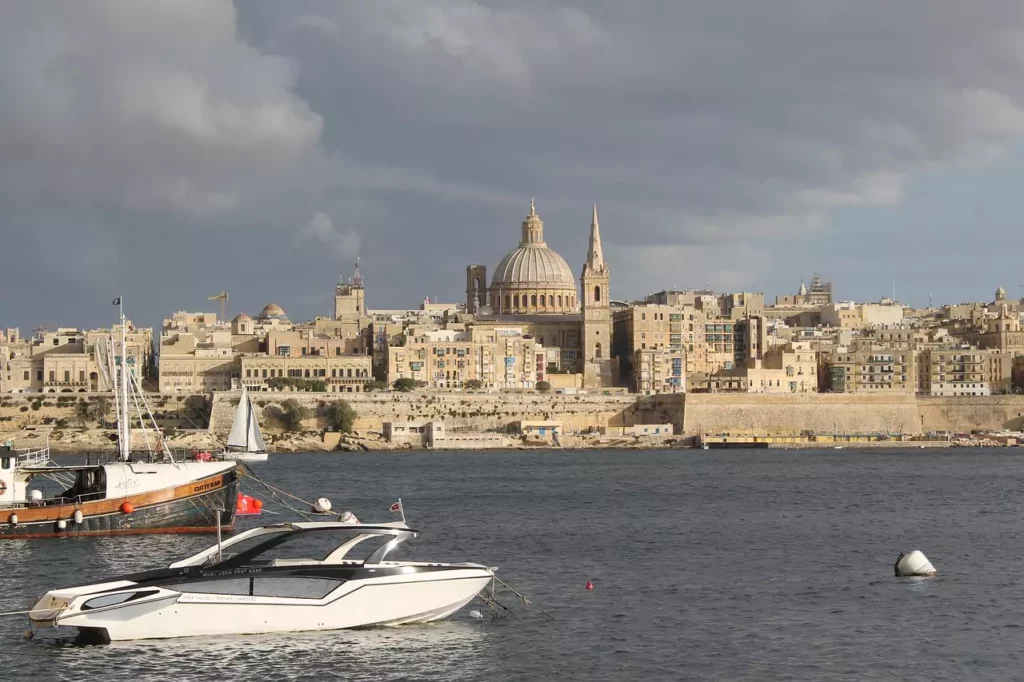
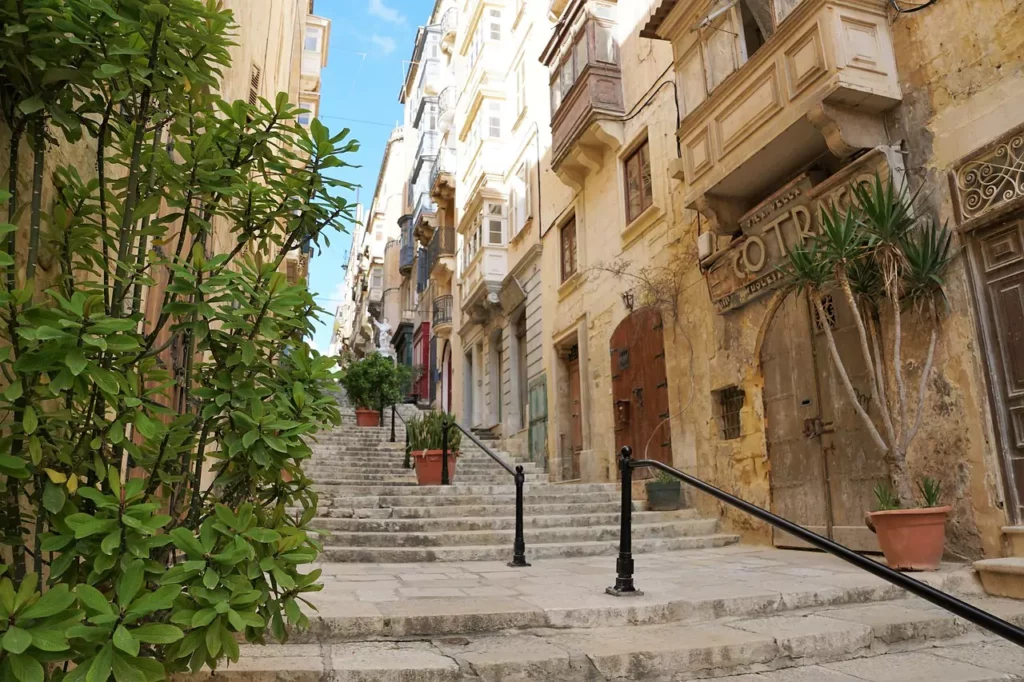
Valletta feels too perfect for summer until you see it in winter. When the tourists are gone and the light softens, the whole city slows to the rhythm of the sea.

You walk down narrow limestone streets that glow gold in the sun. The air smells like espresso and salt. From the fortress walls, you can see fishing boats drifting through Grand Harbour, and for a moment everything goes quiet.

Why Winter Works Here?

In January, while most of Europe hides under clouds, Valletta in winter sits around 17 to 20 degrees. You can wander for hours without sweating or fighting for shade.

Locals greet you like they actually have time, and cafés fill with real Maltese life again. Hotels drop their prices, flights are calmer, and you can get a table with a view without planning weeks ahead.

What to See Without Crowds

Upper Barrakka Gardens – The most peaceful view in the city, with space to sit and breathe.

St. John’s Co-Cathedral – See Caravaggio’s masterpiece without a crowd behind you.

Valletta Waterfront – Still glowing at sunset, the sound now comes from the waves.

Mdina (day trip) – The Silent City truly lives up to its name in winter.

Three Cities ferry – Cross the harbor for a few euros and explore Birgu’s quiet backstreets.

Winter Valletta Is For

Golden-hour walks, cozy restaurants carved into stone, and pretending you live here for a week.
It’s for travelers who chase sunlight, not parties, and love discovering a place that still breathes between seasons.

Wanderlab Tip

Go between November and March. Pack a light jacket, sunglasses, and zero expectations.
Malta in winter isn’t about what to do. It’s about having the Mediterranean to yourself.

Crete in Winter

Crete in Winter – A Different Kind of Greece

Crete in winter doesn’t make sense until you go. The beaches are too cold for swims, the tavernas close earlier, and the streets feel like a film set after the crowds pack up and leave. But that’s the beauty: the island finally exhales.

I walked through Knossos almost alone, no queues, no buses unloading day-trippers. Just me, the stones, and the sound of crows circling above. Later that night in Chania, a café owner slid a glass of raki across the table “to keep warm.” It was 16°C. Not freezing, but the warmth in that glass said everything about Crete in winter: quieter, cheaper, more real.

Crete in Winter: Things to Do, Weather & Why It’s Worth Visiting

First, the weather is kind. It hovers around 15°C, which means you can wander for hours without melting into the pavement like in August.

Second, prices. That boutique hotel with the view of Chania’s Venetian harbor? Half the price. Rental car? Practically begging you to take it.

And most importantly: the absence of everyone else. You get ruins, harbors, and hikes that would normally be jammed in summer will be all to yourself.

You don’t come to Crete in winter to sunbathe. You come for this:


Knossos & Heraklion Museum: usually shoulder-to-shoulder in summer. In January, you can actually hear your own thoughts.

Chania & Rethymno Old Towns:  cobbled streets, Venetian architecture, tavernas that feel like living rooms.

Winter hikes:   the big Samaria Gorge is closed for safety, but smaller gorges (Imbros, Aradena) are perfect in cool weather.

Snow in the White Mountains: yes, Crete gets snow. Standing on the coast while staring at snowy peaks is surreal. Locals even ski when conditions are right.

Food & wine: winter menus lean hearty: lamb stews, snails, wild greens. And locals actually have time to talk instead of rushing plates out to tourists.

A Few Things I Learned

Bring layers. The coast can be 18°C, but head inland and you’ll wish you packed a fleece.

Rent a car. The buses run less often in winter, and Crete is about discovering villages you can’t pronounce.

Forget nightlife. Winter is for slow dinners, raki shots, and maybe one late taverna that doesn’t care what season it is.

Visiting Crete in winter feels like you’ve been let into a secret. It’s not for beaches or parties. It’s for ruins without the rush, mountains with snow, and conversations with people who actually live here.

If you think Greek islands only exist between June and August, Crete will prove you wrong.

Absolutely. It’s not about beaches and bikinis, it’s about ruins without queues, old towns without cruise ships, and cozy tavernas that feel like someone’s living room. If you want quiet + authentic, winter is the season.

Not very. On the coast, it’s usually 12–17°C (55–63°F). In the mountains, though, you’ll see snow and it can drop close to freezing. Pack a jacket and you’ll be fine.

If you’re brave, yes. Locals stick to coffee, not the sea, but you’ll always spot a few Northern Europeans swimming no matter the month.

Most touristy beach resorts close, but the main cities, Heraklion, Chania, Rethymno,  stay alive. Shops, museums, and plenty of tavernas are open year-round.

Yes, often half the summer price (sometimes even less). Crete in January can feel like a bargain if you’re used to July rates.

Yes, but don’t expect the Alps. The White Mountains get snow in winter and there are small ski spots, but the real magic is standing on a beach while staring at snowy peaks.

Ski Resorts in Austria / Without the Skiing

Ski Resorts in Austria / Without the Skiing (Yes, in Summer)

When you think of Austrian ski resorts, you probably picture snowy slopes, après-ski bars, and cozy chalets. But here’s the twist: many of Austria’s world-famous ski resorts are even more magical without the snow. In summer, they transform into green alpine playgrounds filled with hiking, biking, lakes, and mountain culture, minus the crowds and high prices.

Why Visit Austrian Ski Resorts in Summer?

Cheaper stays: Hotels and chalets slash their winter rates.

Fewer tourists: Swap ski crowds for peaceful alpine meadows.

Milder climate: Escape the city heat with cool mountain air.

Outdoor adventures: Trails, lakes, and festivals replace the ski runs.

Best Ski Resorts to Visit in Summer

1. Zell am See-Kaprun

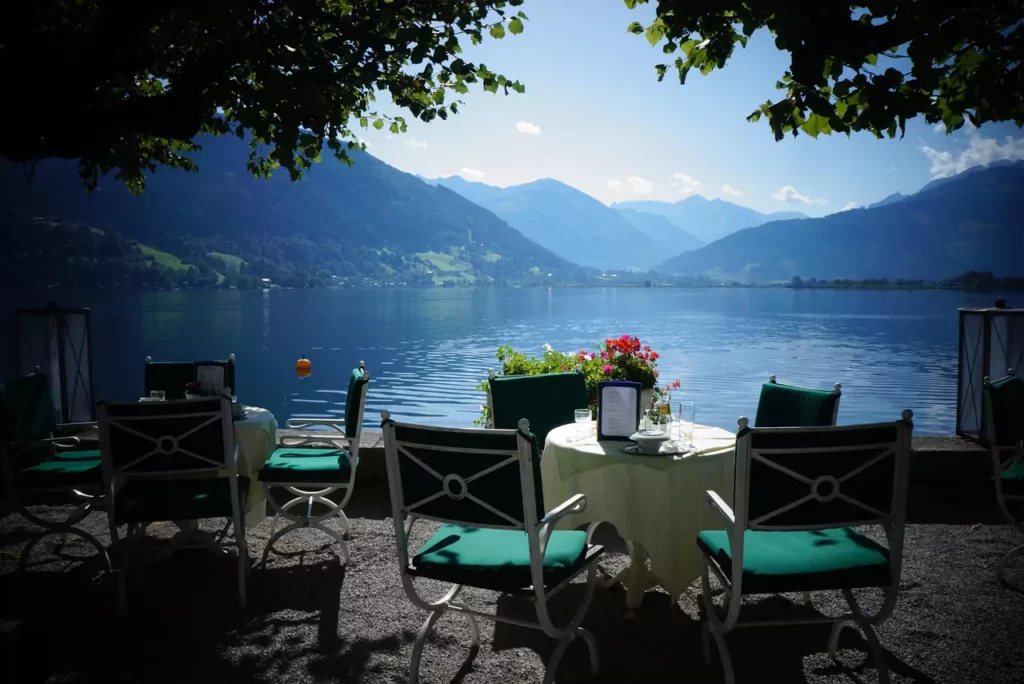
Why go: Glacial views and crystal-clear Lake Zell.

Summer highlights: Swimming, paddleboarding, hiking the Kitzsteinhorn Glacier trails, cycling around the lake.

Local vibe: Cafés and restaurants stay open, but the pace is slower, friendlier.


2. St. Anton am Arlberg

Why go: Famous ski capital, but also a summer hiking hub.

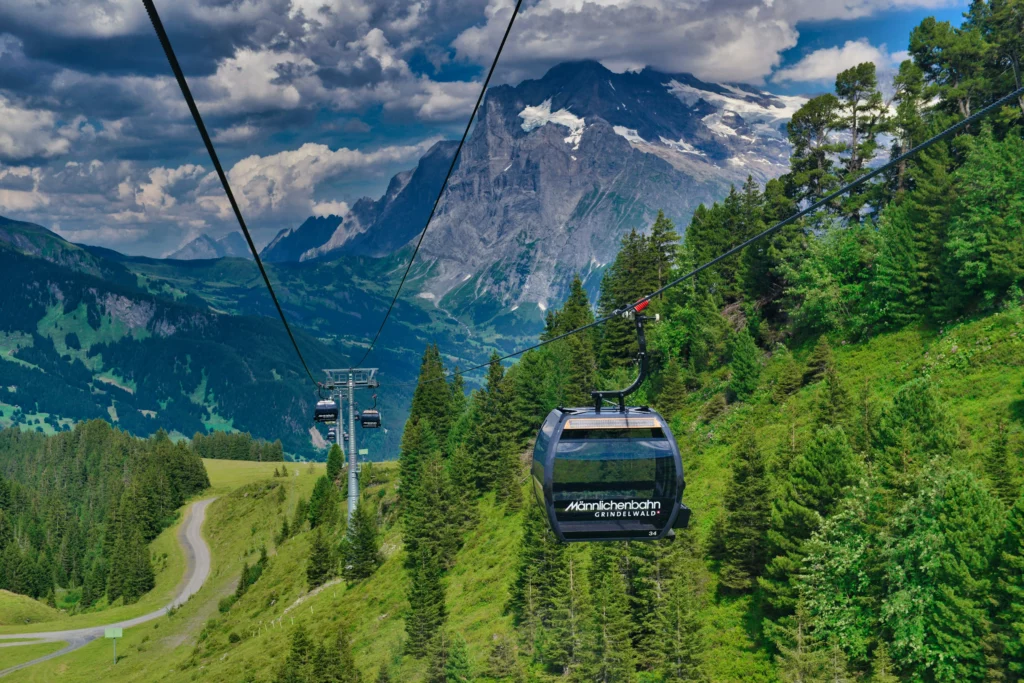
Summer highlights: Mountain biking, alpine meadows, cable car rides with panoramic views.

Hidden gem: Weekly village festivals with Tyrolean music and food.


3. Kitzbühel

Why go: Glamorous in winter, but surprisingly laid-back in summer.

Summer highlights: Golfing, flower-filled hiking trails, and alpine lakes.

Don’t miss: The Hahnenkamm gondola ride,  iconic ski slopes turned summer lookout points.


4. Innsbruck

Why go: A mix of city culture and alpine charm.

Summer highlights: Walk from historic Old Town to Nordkette cable car in minutes. Perfect for urban explorers who want both café culture and mountain views.

things to do when you are not skiing

Mountain biking trails: many ski runs double as bike routes

Hiking: from gentle meadow walks to serious alpine treks.

Lakeside fun: swim, kayak, or just picnic.

Local festivals:  food, music, traditional Tyrolean celebrations.

Yes — most of them don’t shut down when the snow melts. Cable cars still run, mountain huts stay open, and villages like Zell am See, Kitzbühel, and St. Anton shift from ski season to hiking, biking, and lake season. Think wildflowers instead of powder.

Plenty. The ski slopes turn into hiking and biking trails, alpine lakes open up for swimming and paddleboarding, and cable cars still take you up to panoramic viewpoints. Add in village festivals, mountain huts serving hearty food, and golf courses in places like Kitzbühel, you won’t miss the skis.

Definitely. Hotel and chalet prices drop once ski season ends, flights are easier on the wallet, and even après-hike beers are cheaper than après-ski cocktails. Summer in the Alps often costs half of what you’d pay in January.

Driving the Amalfi Coast: Everything You Need to Know

After our Northern Italy road trip, I wrote a general guide on driving in Italy — but the Amalfi Coast deserves its own chapter. Here, traffic, parking, and road culture follow their own rules. If you’re planning to drive along these legendary cliffside roads, here are the essential Amalfi Coast driving tips from our experience.


Choose the Right Car – The Smaller, the Better

Amalfi’s roads are narrow, winding, and parking is limited. A big car is a big mistake. When renting, remember the golden rule: the smaller, the better. A compact car will save you headaches in traffic and when squeezing into tiny parking spots.
We would have loved a classic Fiat 500 or Mini Cooper, but with luggage in tow we settled for a BMW 116 and a Peugeot 208. Both were compact enough to be practical — and still fun to drive.


Always Have Navigation

Don’t skip the GPS. One of our friends insisted on “just reading a map” to save money, but honestly — with endless switchbacks, that would have been a nightmare. Plus, the views are so distracting that nobody in the car will want to keep their eyes on directions. Trust us, get the navigation.


Timing is Everything

In summer, driving the Amalfi Coast can be pure torture. Narrow roads + tourist buses = endless jams. If you can, avoid July and August. The sweet spot is mid-September to May. You’ll skip the gridlock but still get sunshine. If swimming is a priority, aim for early fall or late spring.


Expect Narrow and One-Lane Roads

These are not highways — most Amalfi roads are one lane each way, with sharp turns and steep cliffs. At times you’ll find sections so narrow that only one vehicle can pass at a time, controlled by lights or police. Other times, you’ll round a corner and suddenly face a line of cars waiting because two buses can’t squeeze past each other. Always drive at a speed that lets you stop suddenly. Surprises are part of the Amalfi experience.


Experience Required

These roads are not for new or nervous drivers. They’re narrow, full of blind curves, and often have a sheer drop on one side. Even seasoned drivers get sweaty palms when a coach bus comes barreling around the corner. If you’re prone to panic, let someone else take the wheel. And if you’re the type who drives aggressively, ignores speed limits, or gets angry easily — do yourself (and everyone else) a favor and don’t drive here.


Don’t Skip Insurance

Many Amalfi rental cars already carry scars: scratches, dents, broken mirrors. Get the extra insurance. You’ll thank yourself later.


Local Driving Culture

One of the most refreshing things? Locals are surprisingly patient and helpful with tourists struggling on the road. Sure, you’ll sometimes hear horns (especially in Naples), but on the Amalfi Coast, most drivers will give you space and even help guide you through tight spots.


Watch the Signals

Bus drivers are the true masters of these roads. When space is tight, follow their hand signals — they’ll literally guide you through.
Other signals to know:

  • Horn blasts: Buses honk when approaching blind curves to warn oncoming cars.

  • Flashing headlights: A warning from other drivers — pay attention, something’s ahead.


Parking Like a Pro

Parking is one of the toughest parts of driving Amalfi. Spaces are few, garages are rare, and street parking is tight. Be ready for serious parallel parking practice. Always fold in your mirrors and don’t leave valuables in the car.


Fill Up Before You Go

Gas is more expensive along the coast than on the highways. Top up before heading into Amalfi to save money and avoid stress.


Afraid of Heights? Drive South to North

If sheer drops make you dizzy, start from Salerno and head north toward Positano and Sorrento. That way, you’ll be on the inner side of the road, closer to the cliffs than the edge — while your passengers enjoy the sea views without you sweating bullets.


Wanderlab Insight: Driving the Amalfi Coast isn’t easy — but it’s unforgettable. If you come prepared with the right car, insurance, and patience, it’s one of the most scenic road trips you’ll ever take.

Driving in Italy: What We Learned the Hard Way (So You Don’t Have To)

After our road trip from Turin to Rome, we quickly realized that driving in Italy comes with a few surprises. Here’s everything we wish we knew before renting a car — so you can be prepared and avoid our mistakes.


Renting a Car in Italy

We picked up our rental car in Turin after landing. We had already paid online, but at the desk, they asked to block €2,000 on a credit card as a deposit.

Here’s the problem:
The driver, cardholder, and person who made the reservation must be the same person. One of us had the card, another made the reservation — and the rental company wouldn’t accept it.

Changing the name on the reservation involved calling customer service, which we couldn’t reach on our phones. Eventually, the agent helped us make the call — and 45 minutes later, the name was updated.

Tip: When booking your car, make sure the driver has a credit card with a high enough limit.


Parking in Italian Cities

If you’re planning a road trip in Italy, budget for parking.

  • Blue-lined spots in cities are for paid public parking.

  • They’re free from 8 PM to 8 AM, but during the day, they cost around €1.50 per hour.

  • Use nearby ticket machines, enter the estimated time, and place the printed ticket visibly on your dashboard.

We stayed longer than expected a few times and got a €25 fine. You can pay fines at banks or post offices.

Daily parking garages cost €20–30/day. In Florence, since we didn’t use the car, we parked it in a garage for the entire stay.


Toll Roads in Italy

Italy’s highways are mostly toll roads. Be sure to:

  • Avoid electronic toll lanes (Telepass) unless you have a device.

  • Choose the lanes that give a paper ticket upon entry.

  • Pay at the exit toll booth — sometimes to a person, often to a machine.

Once, we didn’t have enough coins, and the machine didn’t accept our card. We pressed the help button, got a receipt, and paid later at the address provided.

Always carry enough coins in case there’s no attendant.


Fuel Stations

Not every gas station has an attendant. Often, you’ll have to:

  • Pay at the machine

  • Fill the tank yourself

Machines don’t always accept foreign credit cards, so it’s smart to keep some cash handy just in case.


Traffic Fines: The Hidden Cost

This was the biggest surprise. Even after we returned home, fines kept arriving — some were even charged to our credit card months later.

We received speeding and ZTL (limited traffic zone) fines in the mail, long after the trip ended. Honestly, it felt like a never-ending nightmare.

Don’t ignore fines or cancel your card — this could affect future travel within Europe.


Final Advice

Driving through Italy is an incredible experience, but it comes with rules and red tape.
Here’s a quick checklist:

  • Match the driver, credit card, and reservation name

  • Carry coins and cash for tolls and fuel

  • Know where you can and can’t park

  • Follow speed limits and traffic laws strictly

  • Expect parking and toll costs to add up

With the right prep, a road trip in Italy can be a dream. Just be ready for a few bumps along the way — and don’t forget to enjoy the ride!