

If you want to understand a city, don’t start with its monuments.
Start with its banners.
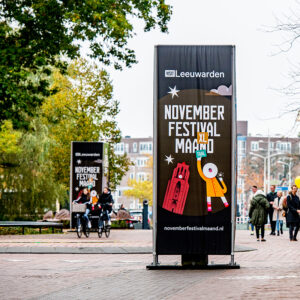
Not the official ones. Not the welcome signs at the station or the tourism slogans on the website. I mean the things hanging above the shopping streets on a random Tuesday. What fills the lamp posts. What gets repeated often enough that locals stop seeing it.
That’s where a city’s real self-image lives, not curated, not dressed up for visitors, just running on habit.
In Leeuwarden, the banners are mostly about shows.
Theatre. Art exhibitions. The Fries Museum. Frisian cultural events. Concerts, festivals, things happening at the Prins Willem-Alexanderhof. Walk through the Nieuwestad on a weekday and the lamp posts are advertising things to experience, not just things to buy.
I noticed this gradually, the way you notice most things about a place you’ve moved to not as a discovery but as a slow accumulation of small observations that suddenly add up.
Other cities advertise differently. Discounts. Chain stores. New housing developments. Fitness offers. Cheap lunch menus. The ordinary management of a functional life. And that kind of advertising tells you something too; it tells you that the dominant public mood is practical, cautious, grounded in what people need rather than what they might feel.
Leeuwarden does have that. Of course it does. But it’s not what the banners reach for.
What the banners reach for is culture. And specifically: Frisian culture.
This is not an accident.
Friesland is one of the few places in Europe that has held onto a minority language with genuine stubbornness not as a heritage project exactly, but as a living daily thing. Frisian is on the road signs. It’s in the schools. It shows up, sometimes unexpectedly, in ordinary conversations. The province has fought quietly for its own distinctiveness for a long time.
The banners are part of that. They are a city saying, repeatedly, to anyone walking through it.That is a particular kind of civic self-confidence. Not loud. Not boastful. But persistent.
I’ve started thinking about what it means to live somewhere that advertises itself through art rather than appetite.
It sets a tone. It shapes what feels normal. What kinds of evenings seem available. What you imagine doing on a Saturday. A city that hangs theatre posters above its streets is making a quiet suggestion about who its residents might be, or who they might want to become.
That’s not nothing.
Advertising is rarely just commercial noise. It’s one of the easiest ways to see what a place assumes people want and what it thinks is worth making visible. A city teaches people what to expect from life partly through repetition. What gets put in front of you again and again starts to define the edges of the ordinary.
In some places those edges are drawn around thrift, routine, consumption. In others around status, glamour, aspiration. In Leeuwarden, they seem to be drawn at least partly around cultural life. Around the idea that a small northern city has something worth seeing, worth hearing, worth coming to.
I’m not saying the banners tell the whole story. They never do.
A city’s official story is told through architecture and history. Its unofficial story is in the shop windows, the noise levels, the faces on a Friday night, the things people line up for. The banners are somewhere in between edited, but not fully managed.
What I find interesting about Leeuwarden’s is what they suggest about self-image. Not buy here or live here for the convenience. More like: we have a culture, and we’d like you to be part of it.
Whether the city fully lives up to that suggestion is a different question.
But it’s a more interesting one to ask than most places give you.
So next time you arrive somewhere new, don’t only look at the buildings.
Read the banners first. Then ask what they’re not saying.
What do the banners look like where you are? I’m genuinely curious whether this pattern holds elsewhere the places that advertise culture versus the ones that advertise convenience, and what that difference feels like to live inside.